


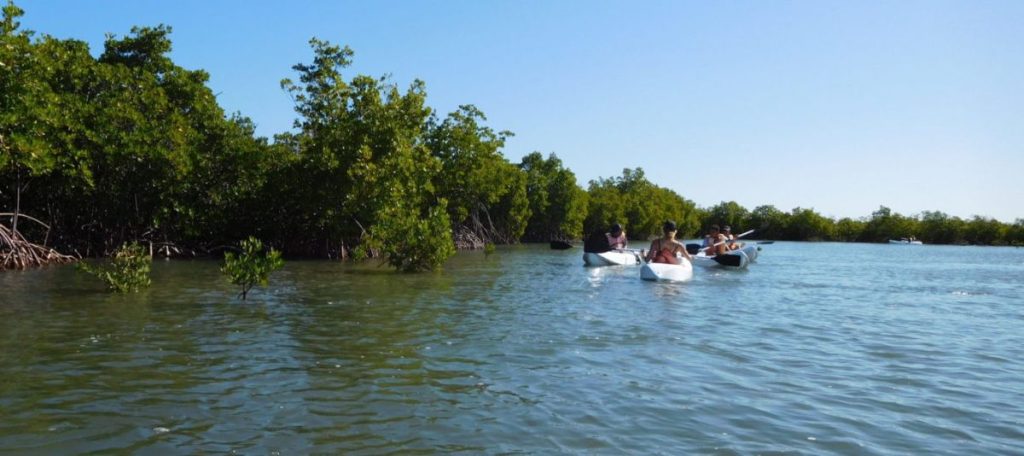
Santo Domingo, Dominican Republic — November 9 — The Dominican Republic is advancing an innovative initiative to restore and conserve mangrove ecosystems while laying the foundation for long-term climate financing through blue carbon markets.
The initiative is being implemented in the provinces of Monte Cristi and Puerto Plata, where mangrove ecosystems face increasing pressures from human activity and environmental degradation. The project brings together four interconnected areas: mangrove restoration, scientific monitoring and measurement, community participation, and sustainable financing. Through this integrated approach, the initiative seeks to demonstrate how mangrove ecosystems can be restored while generating the scientific, institutional and financial foundations needed to attract long-term investment.
Key activities include estimating the blue carbon potential of mangrove ecosystems, assessing the feasibility of participation in carbon markets, designing a measurement, reporting and verification (MRV) system aligned with international standards, supporting alignment with international carbon project registration requirements, and conducting ecological monitoring.
The project will also establish a 550-square-metre forest nursery in Puerto Plata and support the restoration of 10 hectares of mangrove ecosystems in Monte Cristi. Community brigades will participate in restoration activities, helping to connect ecosystem conservation with local livelihoods and community engagement.
A central component of the initiative is the development of a Blue Carbon Exchange Trust, designed to provide a structured mechanism for managing and distributing benefits among participating communities, the private sector and the State.
By combining ecological restoration with scientific monitoring and financial innovation, the project aims to position the Dominican Republic to participate more effectively in emerging international blue carbon markets and strengthen its capacity to mobilise climate finance for coastal ecosystems.
The initiative also seeks to contribute to broader climate objectives, including the development of approaches aligned with Article 6 of the Paris Agreement, while demonstrating how mangroves can be recognised not only as critical ecosystems but also as valuable natural infrastructure capable of supporting climate resilience and sustainable development.
The overall initiative began on 1 October 2024, with the Initial Support and Strategic Partners phase implemented from October 2024 through March 2026. The Dominican Blue Carbon Exchange for the Restoration and Conservation of Mangroves is being implemented by CBF, DEUMAN and Fundación CI-Atabey, with Phase 1 funded by the UK Government through the UK International Development Partnership and supported by the Ocean Risk and Resilience Action Alliance (ORRAA). Fiduciaria Banreservas is also involved in structuring the project’s trust mechanism. The initiative is under the Caribbean BluEFin Project, financed by the Global Environment Facility (GEF), implemented through the United Nations Environment Programme (UNEP), and executed by the Caribbean Biodiversity Fund (CBF). The project is supported by co-financing from the German Development Bank (KfW) on behalf of the German Federal Ministry for Economic Cooperation and Development (BMZ), the French Development Agency (AFD), the French Facility for Global Environment (FFEM), and the German Corporation for International Cooperation (GIZ).
Le Fonds pour la biodiversité des Caraïbes (FBC) est un fonds environnemental régional qui met en œuvre des solutions novatrices et consolide les impacts de la conservation dans les Caraïbes grâce à divers instruments financiers. En concevant et en gérant des solutions de financement innovantes, le FBC aide les pays à accéder à des ressources à long terme pour protéger la biodiversité, renforcer leur résilience climatique et promouvoir une croissance économique fondée sur la nature. À ce jour, le Fonds a soutenu plus de 100 projets dans 12 pays, mobilisant plus de 30 millions de dollars américains pour des solutions efficaces et pilotées localement.
The Dominican Blue Carbon Exchange represents an important step toward creating a more sustainable financing architecture for mangrove conservation—one that connects science, communities, government, private investment and international climate finance.