
Nice, France – In a powerful demonstration of political unity and regional ambition, Caribbean governments today officially launched the Actioning Blue: Caribbean 30×30 Vision for the Ocean political declaration during a high-level event at the 3rd United Nations Ocean Conference (UNOC3).
Held aboard the Art Explorer vessel at Port Lympia, the event was co-hosted by the Government of Grenada, the Caribbean Biodiversity Fund (CBF), the Organisation of Eastern Caribbean States (OECS), and the Ocean Coordination Mechanism Secretariat/ProCaribe+ Project Unit. It marks a historic milestone in advancing marine conservation, governance, and financing across Small Island Developing States (SIDS) in the Caribbean and featured Ministers and high level participants from the OECS, Latin America and Caribbean territories.
A Regional Vision for 30×30
Actioning Blue is a bold Caribbean regional 30×30 Vision and Roadmap for the Ocean and reflects an urgent call by political leaders of the Caribbean to advance collective Caribbean advocacy aligned to the Kunming-Montreal Global Biodiversity Framework and Sustainable Development Goal 14.
This declaration is a renewed call from the Caribbean preceded by the 2008 Caribbean Challenge Initiative that advanced the protection of roughly 49,000 km2 of marine protected areas in the region. The event launched on the opening day of the 3rd UN Ocean Conference aligned with the conference’s ambitious theme. Actioning Blue launches alongside the implementation of the regional OECS 30×30 Transformation Project currently being delivered under the OECS Council of Ministers of Sustainability framework and with financial support of the SPACES coalition.
Through coordinated action, technical assistance, and strategic partnerships, the OECS will help ensure that the Caribbean’s marine ecosystems are not only protected but also contribute meaningfully to climate resilience, food security, and the well-being of its people. We commit to enhancing inter-governmental cooperation, strengthening institutional capacity, driving policy reform and promoting science and research platforms that recognise the role of local communities in marine conservation.
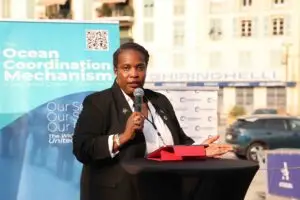
“This is a moment worth celebrating, as it is evidence of what we can achieve through collaboration, persistence and the expertise of our people. Caribbean countries are proving that we are not defined by vulnerability—we are defined by our capacity to lead,” said Hon. Senator Dr. Joyelle Clarke, Minister of Sustainable Development, Environment and Climate Action and Constituency Empowerment for St. Kitts and Nevis.
Caribbean Leadership on the Global Ocean Stage
UNOC3, co-hosted by France and Costa Rica, brings together global leaders under the theme “Scaling up Ocean Action Based on Science and Innovation for the Implementation of Goal 14.” With the launch of Actioning Blue and the Ocean Coordination Mechanism, Caribbean countries are strengthening their collective influence in global ocean governance offering a unified regional approach to help shape international priorities, financing, and cooperation.
“Our strength lies in our unity—and our shared recognition that the triple planetary crises demand a response rooted in regional solidarity and governance that reflects who we are. Let it be known: the Caribbean is not just participating in the global ocean agenda—we are shaping it.”, said H.E. Safiya Sawney, Special Envoy and Ambassador for Climate for the Government of Grenada.
Highlighting the work of the Caribbean Ocean Coordination Mechanism (OCM)
The event also highlighted the important work of the Ocean Coordination Mechanism, a voluntary, government-led platform with a membership of 19 Wider Caribbean nations and nine intergovernmental organizations. The OCM is designed to enhance coordination and collaboration for the sustainable development of the blue economy.
The featuring of these two important regional initiatives at UNOC 3 offers an example of the kind of global south collaboration and coordination we need to deliver on ambitious global goals.
CEO of the Caribbean Biodiversity Fund (CBF), Mrs. Karen McDonald Gayle, noted that the coordinated launch was not a coincidence, “I am pleased to note the agreement not only in words but in efforts demonstrated through joint events like these that the Caribbean Sea and its ocean needs are front and centre – that the waters are bridging the gaps and breaking the silos. So we are working on Marine Management, Governance and financing collectively.”
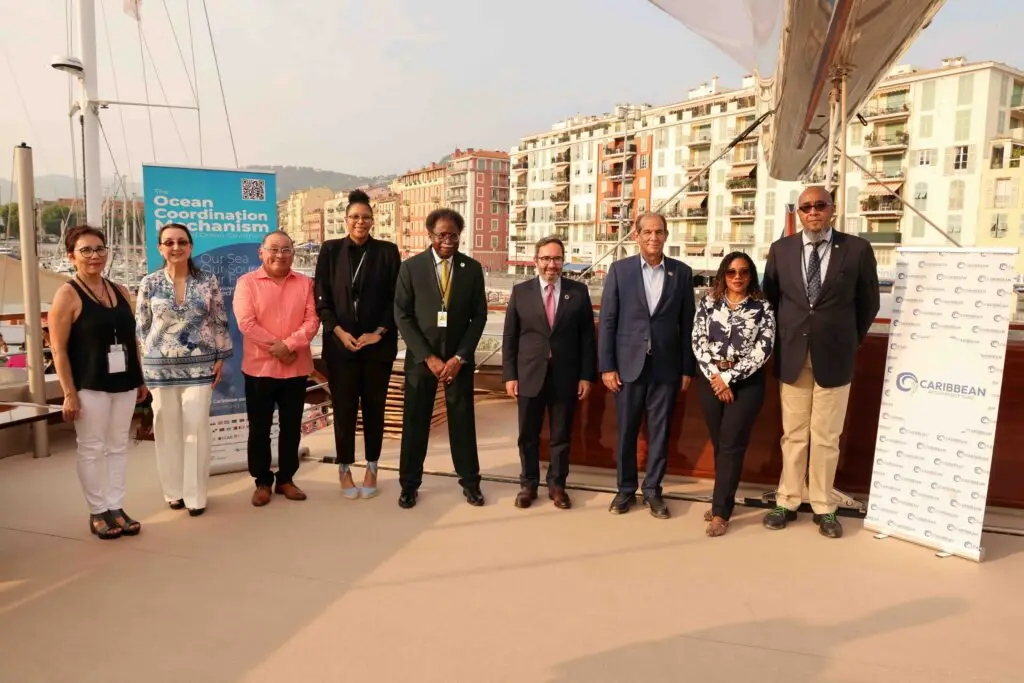
L- R: Mexico’s Undersecretary of Biodiversity and Environmental Restoration Dr. Marina Robles Garcia, Caribbean Biodiversity Fund’s Board Chair Karolin Troubetzkoy, Belize’s Minister of Blue Economy and Marine Conservation Hon. Minister Abner Andre Perez, Grenada’s Special Envoy and Ambassador for Climate H.E. Safiya Sawney, British Virgin Islands’ Vice Premier Hon. Julian Fraser RA, UN Under-Secretary-General and UNOPS Executive Director Jorge Moreira da Silva, Dominican Republic’s Vice Minister of Environment and Natural Resources Hon. Jose Ramon Reyes, Antigua & Barbuda’s Deputy Parks Commissioner and Climate Ambassador Ruleta Camacho-Thomas and the Permanent Observer of the Organisation of Eastern Caribbean States (OECS) to the United Nations Office at Geneva H.E. Colin Murdoch.

À propos du Fonds pour la biodiversité des Caraïbes (FBC)
Le Fonds pour la biodiversité des Caraïbes (FBC) est le fonds environnemental régional de référence pour les Caraïbes. Il a pour mission de préserver la nature et d’améliorer les conditions de vie dans toute la région. En concevant et en gérant des solutions de financement innovantes, le FBC aide les pays à accéder à des ressources à long terme pour protéger la biodiversité, renforcer leur résilience climatique et promouvoir une croissance économique fondée sur la nature.
Le Fonds pour la conservation des Caraïbes (CBF) gère trois programmes stratégiques qui génèrent un impact dans toute la région : le financement de la conservation via une dotation régionale, l’adaptation au changement climatique axée sur les approches écosystémiques (EbA) et les économies fondées sur la nature qui soutiennent les modèles d’économie circulaire. Ces programmes collaborent activement avec les gouvernements, les communautés et les partenaires de développement des Caraïbes afin de promouvoir des objectifs environnementaux communs et une durabilité à long terme. À ce jour, le Fonds a soutenu plus de 100 projets dans 12 pays, mobilisant plus de 104 000 millions de dollars américains pour des solutions efficaces et pilotées localement.
About the Organisation of Eastern Caribbean States (OECS)
L’Organisation des États de la Caraïbe orientale (OECO) a été créée le 18 juin 1981, lorsque sept pays de la Caraïbe orientale ont signé le traité de Basseterre, du nom de la capitale de Saint-Kitts-et-Nevis, où l’accord a été signé. Ce traité a marqué un engagement à promouvoir la coopération, l’unité et la solidarité entre les États membres. Les États membres de l’OECO sont : Antigua-et-Barbuda, le Commonwealth de Dominique, la Grenade, Montserrat, Saint-Kitts-et-Nevis, Sainte-Lucie et Saint-Vincent-et-les-Grenadines. Les îles Vierges britanniques, Anguilla, la Martinique, la Guadeloupe et Saint-Martin sont des États membres associés.’
Contact:
OECS: Danny Moonie – [email protected]
CBF: Renée Smith – [email protected]