
Estado
En curso
El Effective Marine Protected Area Activities for the Caribbean (EMPAC) project is a regional initiative designed to enable partnerships and advance a Caribbean Action Plan towards achieving sustainably funded and effectively managed marine areas.
Financiado por la Alianza de la Naturaleza Azul with a contribution of USD 750,090, the project is being implemented by the Caribbean Biodiversity Fund (CBF) over three years through 2026. EMPAC is particularly timely as Caribbean governments and key stakeholders work to advance the Kunming-Montreal Global Biodiversity Framework (GBF) and its 30×30 target to conserve and effectively manage at least 30% of the world’s land and ocean by 2030.
The project aims to catalyze support for the designation, effective management, sustainable financing, and expansion of Marine Protected Areas (MPAs) and Marine Managed Areas (MMAs) across the Caribbean, while strengthening coordination at both national and regional levels.
The Caribbean marine environment supports more than 10% of the world’s coral reefs, alongside extensive mangrove forests and seagrass beds. These ecosystems underpin food security, livelihoods, economic stability, and climate resilience across the region. Yet they face growing pressures, while many Caribbean Small Island Developing States (SIDS) have limited financial and technical capacity to respond.
Key pressures include:
Globally, only 8.2% of the ocean is protected, and an estimated 2.7% is effectively managed. This underscores the need not only to expand marine protection, but to ensure that protected areas are adequately financed and effectively managed.
The Caribbean has important foundations for action, including strong political commitment to 30×30, established conservation trust funds, and regional institutions capable of mobilizing and deploying resources. However, significant gaps remain in capital at scale, enabling policy and governance conditions, and sustainable financing for effective MPA management.
A growing window of opportunity is also emerging. Global momentum around 30×30, greater alignment between climate and biodiversity finance, increased recognition of SIDS vulnerability, an evolving regional ocean finance architecture, and a maturing blue bond market create new opportunities to strengthen marine conservation across the Caribbean.
EMPAC responds by strengthening the enabling conditions, financing, partnerships, and institutional capacity needed to translate regional commitments into effective and sustainable marine management.
EMPAC is being delivered through three key components:
Through these activities, EMPAC supports Caribbean countries in advancing UN Sustainable Development Goal 14 (Life Below Water) and contributing to the Global Biodiversity Framework’s 30×30 target, while fostering stronger regional partnerships and more sustainable approaches to marine conservation.
Throughout the project, CBF has delivered a series of high-level interventions to strengthen policy, regional coordination, and sustainable financing for marine 30×30. Key results include:
CBF conducted an in-depth assessment of the policy, institutional, capacity, and financing gaps affecting MPAs across the Caribbean. The findings provided an evidence base for identifying priorities and informing subsequent regional interventions.
The analysis identified significant gaps in financing, institutional capacity, and governance, including an estimated US$576 million annual financing gap for marine conservation across the Caribbean.
Key barriers to achieving 30×30
 Reliance on short-term funding and limited revenue retention
 Limited data and monitoring for decision making
 Weak legal and policy frameworks
 Fragmented governance and weak regional coordination
 Gaps in staffing, equipment, and enforcement
 Misalignment with climate & blue economy strategies
In 2025, CBF partnered with regional ocean leaders to develop Actioning Blue: A Caribbean 30×30 Vision and Roadmap for Our Ocean. The Caribbean-led declaration provides a shared regional framework for advancing marine 30×30 by connecting global biodiversity commitments with coordinated regional action and sustainable financing.
Building on the momentum of the Caribbean Challenge Initiative and endorsed through the Organisation of Eastern Caribbean States (OECS), the declaration has since been adopted by 15 Caribbean governments and strategic partners, strengthening political and regional support for coordinated action toward 30×30.
 Anguilla
 Antigua y Barbuda
 Belice
 British Virgin Islands
 Dominica
 República Dominicana
 Granada
 Guadeloupe
 Jamaica
 Martinique
 Montserrat
 Saint Kitts and Nevis
 Santa Lucía
 Saint Martin
 Saint Vincent & the Grenadines
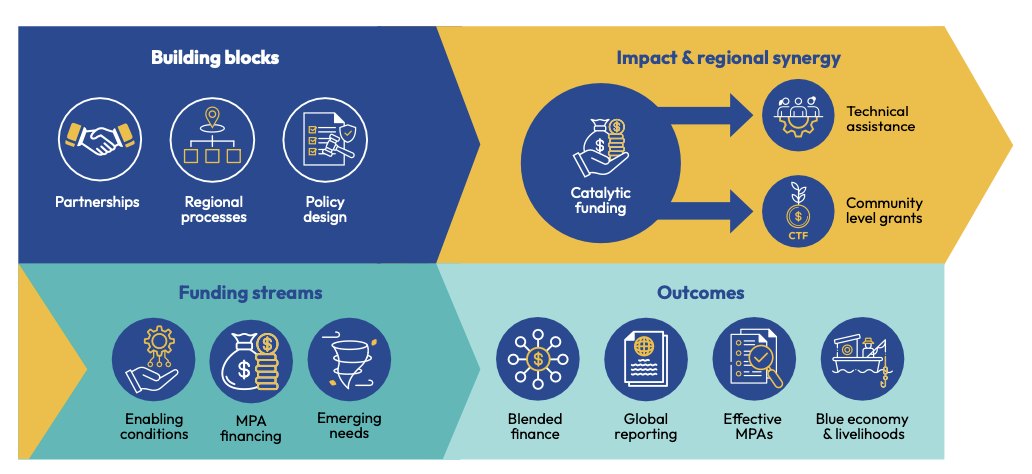
Launched in June 2026, the Caribbean MPA Finance Facility provides a regional platform to mobilize and deploy funding at scale and accelerate progress toward the Global Biodiversity Framework’s 30×30 target.
The Facility responds to persistent financing gaps by pooling resources, coordinating regional investment, and aligning funding with national priorities to support long-term conservation outcomes.
Designed to mobilize US$250 million through endowment, sinking, or hybrid financing structures, the Facility will provide catalytic funding through a network of nationally rooted Conservation Trust Funds and local partners. By leveraging existing institutions and systems, it aims to reduce transaction costs for small island developing states (SIDS) and move beyond fragmented project-based grants toward a more coordinated and scalable blended-finance approach.
The Facility will support three broad areas:
 In the News
Source: Climate Tracker Caribbean
Read Article
In the News
Source: Climate Tracker Caribbean
Read Article
In the News
Source: OECS Pressroom
Read Article
In the News
Source: IISD SDG Knowledge Hub
Read Article
In the News
Source: OECS Pressroom
Read Article